
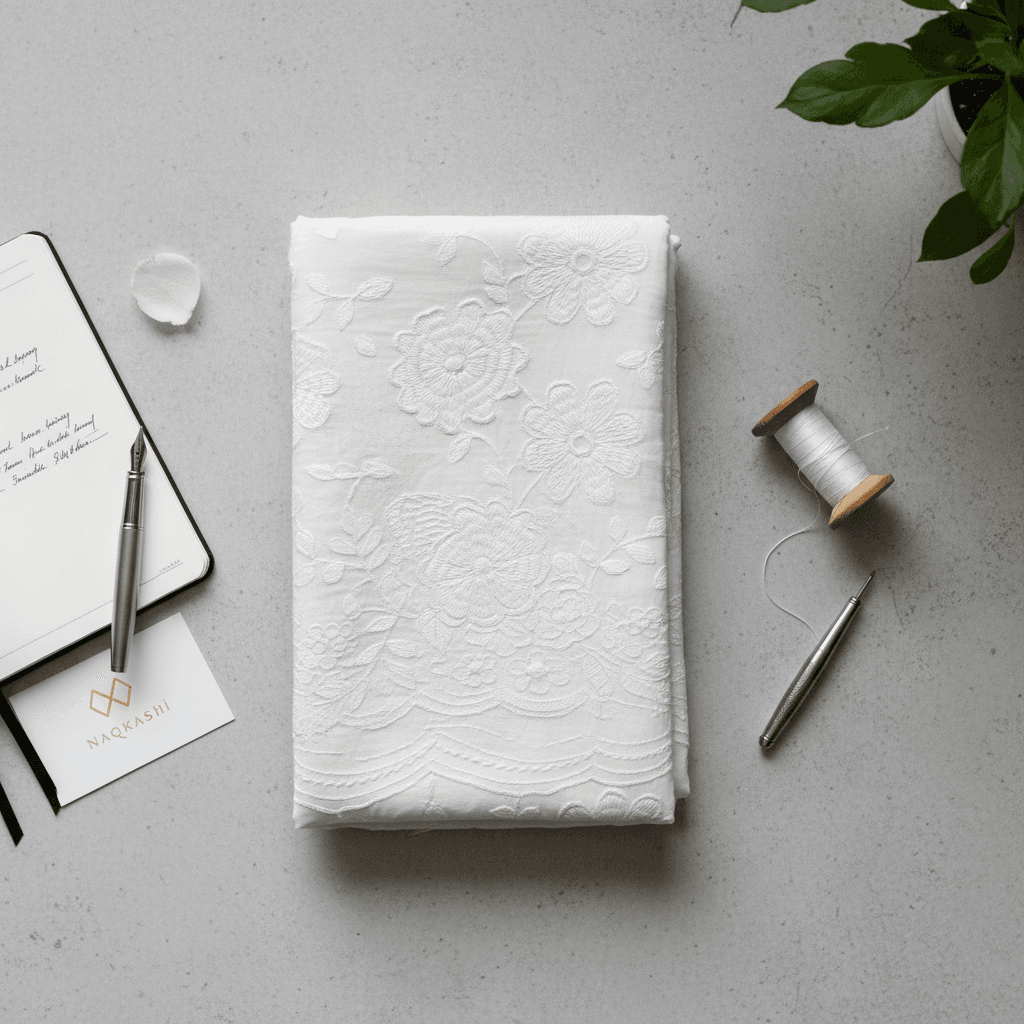
In the heart of India, where culture intertwines with artistry, lies a textile tradition that transcends mere clothing to become a veritable canvas of dreams: Chikankari. For generations, this exquisite embroidery has captivated connoisseurs with its ethereal beauty, delicate motifs, and the silent poetry woven into every thread. At Naqkashi, we celebrate this enduring legacy, presenting a collection that embodies the pinnacle of luxury chikankari, a testament to timeless elegance and unparalleled craftsmanship. As guardians of this heritage, we invite you to delve into the enchanting world of Chikankari, an art form that finds its soul in the historic city of Lucknow and its expression in the hands of master artisans.
Chikankari, at its essence, is a delicate and intricate form of hand embroidery, renowned for its subtle beauty and sophisticated charm. Unlike more flamboyant embellishments, Chikankari whispers rather than shouts, its allure lying in its understated elegance and the painstaking precision required for its creation. It is an art form that transforms simple fabrics into masterpieces, making each piece a testament to human skill and aesthetic sensibility. The patterns, often inspired by nature – florals, paisleys, and intricate vine motifs – are imbued with a sense of organic grace, reflecting a deep connection to the natural world.
The narrative of Chikankari is inextricably linked with the historic city of Lucknow, the capital of Uttar Pradesh. Often referred to as the ‘City of Nawabs,’ Lucknow is a crucible of refined culture, aristocratic living, and artistic patronage. It was under the benevolent gaze of the Mughal emperors and later the Nawabs of Awadh that Chikankari truly flourished, evolving from a simple craft into a sophisticated art form. Legend has it that Nur Jahan, the empress consort of Emperor Jahangir, introduced Chikankari to India in the 17th century, drawing inspiration from Persian embroidery. The mild climate of Lucknow, coupled with its rich cotton cultivation, provided the perfect environment for this delicate art to take root and blossom. The Nawabs, known for their opulent lifestyles, discerning tastes, and patronage of the arts, championed Chikankari, commissioning intricate garments for their court. This royal patronage elevated Chikankari to a symbol of status and refinement, embedding it deeply into the cultural fabric of Lucknow. The city’s unique blend of Persian, Mughal, and indigenous influences permeated every aspect of life, from architecture and cuisine to poetry and sartorial elegance, and Chikankari became the quintessential expression of Lucknowi ‘tehzeeb’ – its cultured etiquette and sophistication. Owning a piece of authentic Lucknowi Chikankari was, and remains, a mark of discerning taste, a tangible link to a glorious past.
The true magic of Chikankari lies in its meticulous craftsmanship, a multi-stage process that is as demanding as it is rewarding, requiring exceptional skill, patience, and an artistic eye. Each piece of Chikankari is a product of collaboration, touching the hands of several specialized artisans before it reaches its final, perfected state. The journey begins with the ‘Chapai’ or block printing stage. Master block printers delicately imprint the desired design onto the fabric using fugitive dyes that will wash away later. These designs, often passed down through generations within artisan families, are the soul of the embroidery.
Following the printing, the fabric moves to the ‘Chikai’ or embroidery stage, where the true artistry unfolds. It is here that the skilled ‘karigars’ or embroiderers, predominantly women, bring the designs to life. Their hands, guided by centuries of tradition, meticulously weave patterns with a needle and thread, transforming flat fabric into a textured marvel. This is the most time-consuming and intricate part of the process, demanding immense precision and dedication. The karigars often work in specialized clusters, each focusing on specific stitches, ensuring unparalleled mastery in their designated craft. The dexterity and nuanced understanding of these artisans are what imbue each Naqkashi garment with its unique character and exquisite finish.
Once the embroidery is complete, the fabric undergoes a rigorous ‘Dhulai’ or washing process. The fugitive dyes used for printing are carefully washed off, ensuring that only the pristine white or subtly colored embroidery remains, leaving behind a clean canvas adorned solely by the delicate threads. This stage requires careful handling to preserve the integrity of the delicate stitches. Finally, the garment is starched and ironed, preparing it for its journey to connoisseurs around the world.
The repertoire of Chikankari stitches is vast and diverse, with each stitch lending a unique texture and effect to the overall design. It is this intricate interplay of different stitches that gives Chikankari its remarkable depth and subtlety. Among the myriad stitches that compose this intricate art form, one finds the graceful Tepchi, a long running stitch that often outlines the initial design, forming the foundational framework of many patterns. Then there is the celebrated Bakhiya, often referred to as shadow work, which is meticulously executed from the reverse side of the fabric to create a subtle, ethereal shadow effect on the front, lending an illusion of depth and luminosity. The Jaali work, a distinctive feature of Chikankari, involves delicately pulling apart threads to create an open-net pattern without cutting the fabric, a testament to the artisan’s extraordinary precision. Phanda and Murri are tiny, knot-like stitches, resembling small millet seeds, used to create raised patterns and fill spaces with delicate texture. Phanda is typically larger, while Murri is finer.
Other exquisite stitches include Hool, an eyelet stitch often used to create delicate holes that resemble tiny flowers; Zanzeera, a fine chain stitch; and Rahet, a stem stitch used for creating intricate leaf and stem designs. Darzdari is a flat stitch that gives a smooth, dense finish, while Ghaspatti creates delicate leaf motifs. Kauri is a stitch that resembles small shells, adding a tactile dimension. Bijli, meaning lightning, is another unique stitch that adds a sparkling effect. Each stitch is a universe unto itself, and the combination of these various techniques, often within a single motif, results in the breathtaking complexity and elegance that defines luxury Chikankari. The mastery of these diverse stitches, passed down through generations, is what truly elevates a Naqkashi garment from mere clothing to a wearable work of art.
While deeply rooted in tradition, Chikankari has gracefully transitioned into the lexicon of modern fashion. Once primarily seen on traditional kurtas and sarees, its versatility has allowed it to adorn contemporary silhouettes, from elegant tunics and dresses to sophisticated blouses, palazzos, and even Western fusion wear. The initial ‘white-on-white’ classic Chikankari, while timeless, has evolved to incorporate delicate pastel hues and even vibrant color combinations, enhancing its appeal to a wider audience. The choice of fabrics has also expanded beyond traditional mulmul and cotton to luxurious georgettes, chiffons, silks, and organzas, lending a richer drape and a more opulent feel, perfect for high-fashion statements.
Chikankari pieces now grace diverse occasions, from casual daywear to grand festive celebrations, formal events, and even bridal trousseaus. Its delicate elegance makes it a perennial favorite for those who appreciate understated luxury and craftsmanship. Internationally, Chikankari has garnered significant attention on global runways and in elite fashion circles, recognized for its unique artistry and ethical handcraftsmanship. It stands as a powerful symbol of sustainable luxury, celebrating the skill of human hands over mass production.
At Naqkashi, we are more than just a fashion brand; we are custodians of a cherished legacy. Our philosophy is built on a profound reverence for the art of Chikankari and an unwavering commitment to unparalleled quality. We handpick the finest fabrics and collaborate with master artisans who embody generations of skill and dedication. Each Naqkashi creation is a tribute to the original spirit of Chikankari – meticulously hand-embroidered, authentically Lucknowi, and exquisitely finished. We believe in providing our patrons not just with clothing, but with an heirloom piece, a wearable narrative of Indian heritage and craftsmanship. Our ethical practices ensure fair remuneration for our karigars, supporting their craft and enabling them to continue this beautiful tradition. By choosing Naqkashi, you are not merely acquiring a garment; you are investing in a piece of living history, a masterpiece of textile art that carries the soul of Lucknow and the enduring spirit of human ingenuity.
To preserve the delicate beauty and longevity of your Naqkashi Chikankari, we recommend gentle hand washing in cold water with a mild detergent, or professional dry cleaning. Avoid harsh chemicals and direct sunlight when drying, and iron on a low heat setting, preferably on the reverse side. With proper care, your Chikankari garment will continue to enchant for years to come, a testament to its enduring quality and timeless charm.
In an era of fleeting trends and mass-produced fashion, Chikankari stands as a beacon of enduring elegance, a gentle reminder of the beauty that arises from patience, precision, and passion. It is an art form that transcends time, connecting us to a rich cultural past while remaining vibrantly relevant in the contemporary world. Naqkashi is proud to present this magnificent legacy, inviting you to experience the sublime luxury and ethereal embrace of authentic Chikankari, a true masterpiece woven with dreams and the unparalleled skill from the heart of Lucknow. Discover the poetry of threads, the whisper of history, and the timeless allure of Chikankari with Naqkashi.