
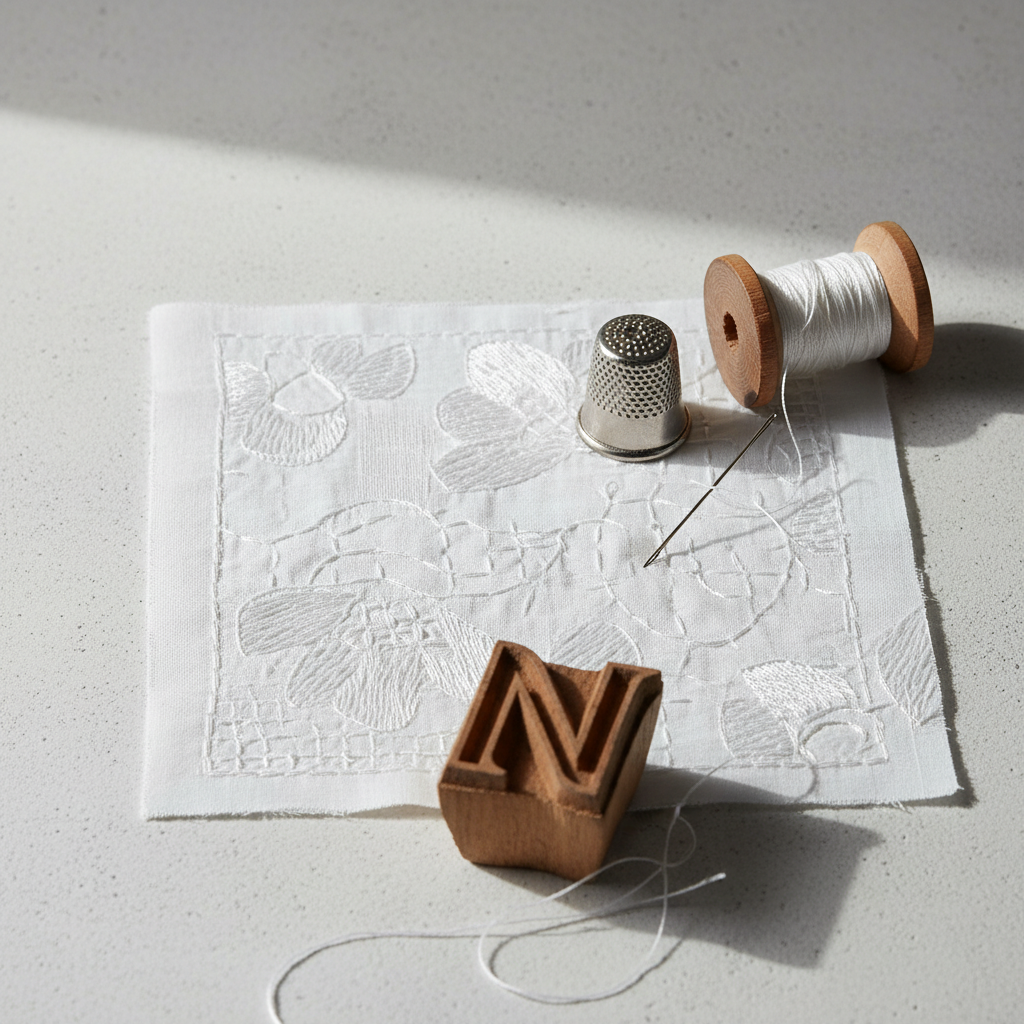
In the bustling world of fashion, where trends flicker and fade with the speed of a digital scroll, there exists a quiet revolution – a return to authenticity, to craftsmanship that whispers stories rather than shouts for attention. As a purveyor of luxury Chikankari, we at Naqkashi are intimately familiar with the intricate dance between tradition and modernity, and perhaps no debate is more central to our ethos than the distinction between handmade and machine embroidery. It’s not merely a technical difference; it’s a chasm between soul and efficiency, heritage and haste. Let us unveil the profound reasons why the human touch remains irreplaceable in the creation of true Chikankari.
**The Artisan’s Breath: The Poetry of Hand-Embroidered Chikankari**
Imagine a weaver, hunched over a frame, needle dancing through fabric, each stitch a deliberate act, a moment of focused artistry. This is the heart of `Handmade Chikankari`. At Naqkashi, our pieces are born from the hands of master artisans in Lucknow, whose skills have been passed down through generations. Each *tepchi*, *bakhiya*, *jaali*, or *phanda* is unique, carrying the subtle variations that only a human hand can impart.
* **Depth and Dimension:** Hand embroidery inherently possesses a nuanced texture and a subtle three-dimensionality. The stitches lie differently, catch the light in varying ways, creating an organic flow and depth that feels alive. This `Artisanal Chikankari Craftsmanship` offers a richness that machine work simply cannot replicate.
* **The Signature of Imperfection:** True beauty often lies in imperfection. A slight variation in stitch length, a nuanced angle – these are not flaws but signatures of the human hand, ensuring that no two handmade pieces are ever identical. This `Unique Hand Embroidery` is what gives each Naqkashi garment its distinct character and heirloom quality.
* **Ethical Craft and Sustained Livelihoods:** Choosing `Luxury Hand Embroidery` like Naqkashi’s is an investment in `Ethical Textile Practices`. It directly supports the livelihoods of skilled artisans, preserves a centuries-old craft, and promotes `Slow Fashion Chikankari` principles, valuing quality and heritage over mass production.
**The Whir of the Machine: Efficiency vs. Essence**
On the other side of the spectrum lies machine embroidery. While undoubtedly efficient and capable of producing intricate patterns at speed and scale, it operates on a fundamentally different principle.
* **Uniformity Over Individuality:** Machine embroidery aims for absolute precision and uniformity. Every stitch is identical, creating a flat, often rigid appearance. While this might appeal to certain aesthetic sensibilities, it lacks the organic flow and individual charm of `Hand-Embroidered Fabric`.
* **Lack of Tactile Depth:** The automated process often results in a flatter finish, with less distinction between the base fabric and the embroidery itself. It misses the subtle rise and fall, the soft texture that defines authentic Chikankari. This `Machine-Made Embroidery` often feels less supple to the touch.
* **Cost vs. Value:** Machine-embroidered garments are generally more affordable due to faster production times and reduced labor costs. However, this comes at the expense of the unique narrative, the longevity, and the intrinsic value of a handmade item.
**Discerning the Difference: A Touch and a Gaze**
How can one differentiate between the two?
1. **Look at the Back:** A tell-tale sign of `Authentic Lucknowi Chikankari` is a clean finish on the reverse, often called “shadow work.” Machine embroidery will typically have a messy underside with loose threads and knots.
2. **Feel the Texture:** Run your hand over the embroidery. Handmade Chikankari will feel soft, supple, and slightly raised, with an organic, almost cushion-like quality. Machine work can feel flatter, sometimes stiffer or even slightly coarse.
3. **Examine the Stitches:** With `Artisanal Handwork`, stitches might show minor variations in tension or size, even in the most skilled hands. Machine stitches are unnervingly uniform and repetitive. Look for the distinct, delicate holes of the *jaali* work in genuine Chikankari – machine often struggles to replicate this openwork effect authentically.
**Naqkashi’s Pledge: The Legacy of a Living Art**
At Naqkashi, our commitment to `Heirloom Chikankari` means an unwavering dedication to the human hand. We believe that true luxury is not just about opulent materials, but about the story, the skill, and the soul woven into every thread. When you choose a Naqkashi garment, you’re not just buying a piece of clothing; you’re investing in `Luxury Indian Heritage`, supporting the preservation of a magnificent art form, and owning a masterpiece of `Genuine Chikankari Craftsmanship` that carries the unparalleled beauty of human endeavor. Experience the `Naqkashi Difference` and embrace the lasting elegance of `Hand-Embroidered Luxury Fashion`.